Woolly mammoths alongside humans
Our data suggest that horses and woolly mammoths may have persisted in the Klondike until approximately 9,000 years ago and perhaps as recently as 5,700 years ago, outliving their supposed disappearance from local fossil records by 7,000 years. However, it is possible for ancient environmental DNA to survive erosion and re-deposition, which could mix the genetic signals of different time periods, necessitating a degree of caution in our interpretations.
Until recently, there was no evidence of mammoth survival into the mid-Holocene. But studies have now shown that mammoths survived until 5,500 and 4,000 years ago on Arctic islands.
Researchers at the Centre for GeoGenetics in Copenhagen found evidence for the late survival of horses and mammoths in Alaska until as recently as as 7,900 years ago. They also found evidence of mammoths surviving as recently as 3,900 years ago in Siberia, alongside woolly rhinoceros to at least 9,800 years ago.
Steppe bison, which were thought to have disappeared and been replaced by the American bison during the Pleistocene, have likewise been found to have survived even as recently as perhaps just 400 years ago. We were able to observe the presence of distinct genetic lineages of both woolly mammoths and steppe bison in the same sediment samples, which suggests that there were likely distinct populations of these animals living in the same area.
There is a growing body of evidence that many ice age megafauna probably survived well into recorded human history, roaming the north during the Bronze Age and while builders worked on the pyramids of Egypt.
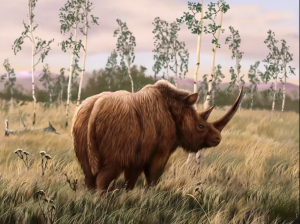 Researchers in Denmark found evidence of woolly rhinoceroses surviving in Siberia at least 9,800 years ago. Shutterstock
Genetic archives of our ecological past
The growing sophistication of environmental DNA methods to study ancient genetic microfossils highlights just how much information is buried in sediments.
Permafrost is ideal for preserving ancient DNA, but as this perennially frozen ground thaws and degrades with a warming Arctic, so too will the genetic material preserved within, and the evolutionary mysteries they once held.
Advances in paleogenetics continues to push the boundaries of what was once relegated to science fiction. Who knows what undiscovered evolutionary information remains frozen in ordinary sediments, hidden in microfossils of ancient DNA?
Tyler J. Murchie, Postdoctoral fellow, Anthropology, McMaster University
This article is republished from The Conversation under a Creative Commons license. Read the original article.